Monday, July 18, 2016

Theft Alert! Greubel Forsey Invention Piece Number 1

Please spread the word - The Greubel Forsey Invention Piece Number 1 with serial number 10/11 belonging to an Indonesian collector has been stolen.


 photo Greubel Forsey IP1 IMG_20160714_035435_zpsmue0m3r1.jpg

Photo credit to @thehorophile

The Indonesian owner is @indohorology and he still has the papers to prove ownership. Should you come across the piece, kindly inform your local authorities or you may contact @indohorology via Instagram message. Kindly spread the word and we hope the timepiece can be returned to the rightful owner soon enough.

Sunday, July 17, 2016

REC Watches - Recover - Recycle - Reclaim

The concept of REC Watches is to salvage and transform classic icons into timepieces, a concept which we named RECOVER – RECYCLE – RECLAIM, or just REC for short. That's how the folks at REC Watches introduce themselves.

The concept of Recover-Recycle-Reclaim is not new, not that REC Watches claim that they are the first but the way they went about it is interesting. I have also blogged about Blancier Grand Cru in 2013 and they up-cycles used Nespresso capsules using them as the dials. Ingenuous I say!

Funded through Kickstarter, REC Watches which is based on Denmark has an interesting approach to how they make their timepieces unique. REC Watches actually purchase old parts from the vintage Ford Mustang cars and uses these parts to make the dials. Therefore, no two timepieces are alike - similar but not alike, therefore making them unique. I came to know about REC Watches through Kickstarter and thought it was a nice idea, hence bought the P-51-03. The two founders are Jonathan Kamstrup and Christian Mygh.

All their P-51 Mustang series timepieces come with a history - they tell you which year the Ford Mustang came from and also the Vehicle Identification Number (VIN) of the car. In my case, the dial is made from a vintage Mustang from 1965 with the VIN 5F08A787123. This can be found on the VIN plate at the 11 o'clock position on the main dial. I love the "raw" texture of the dial.

Not only do they tell you the year of the model, the good folks at REC go one step further in producing a video showing you the actual car they salvage the part from. When you receive the timepiece, you will also receive a card with a printed QR code. Scan that QR code and it will bring you the video explaining how the part was recovered and a little history of the vintage Mustang it came from.

I particularly like the off centre layout of the timepiece. The power reserve is presented like a fuel gauge at the 12 o'clock position in line with the automotive theme.

And the time display is integrated with the date.

I really like the fact that the dials are unique. In this case, I believe the bonnet was used and it yielded 350 timepieces. But each timepiece is unique as each as the part used us different. Did I mention I like the "raw" feel of the dial? Look at the texture on the dial... almost like a rusty hue.

And each and every scratch is probably unique to the timepiece.

Notice the scratch across the dial just under the VIN plate?

Finishing on the dial side is decent.

On the reverse side shows the automatic movement - not particularly impressive but a reliable movement nonetheless. The folks at REC chose to use the Miyota 9130 automatic movement that features a power reserve and also a small date function. The strap for the timepiece also comes with a quick release function - nicely done REC!

The serial number is also indicated on the back of the watch and in this case is number 0095. What is unique is also the information of how many timepieces were made from this batch. So I guess this is the "Limited Edition" so to speak as only 350 timepieces were made from this recovery.

According to the brand, the case is a four part case. Pretty well made I must say. Nice curves, well polished bezel and a signed crown.

The timepiece is large for my small wrist. The case is 44mm and with a polished bronze bezel.

The timepiece comes with a black leather strap that has a quick change function at the back. The perforated leather is reminiscent of the steering wheel covers of old. Another nice touch. And for the Kickstarter backers, they included an extra olive strap as a reward for backing them.

The buckle is bronze colour and signed too.

Overall a nice package at a reasonable price point.

A nice story and an equally nice timepiece for the story. Who would think a Danish watch brand will use an American icon to their advantage. But nicely done REC!

Wednesday, July 13, 2016

The Beauty of the Montblanc Villeret Vintage Pulsographe

It was love at first sight for me when I saw the Villeret 1858 Vintage Pulsographe and then I had to find out more about the timepiece.

I had acquired the rose gold black dial version and I blogged about it on Deployant. As you may know, the Vintage Pulsographe comes in two tones - the rose gold black dial version and the white gold white dial version. Both comes with Grand Feu enamel dials - beautifully fired enamel dials. So I had to find the white gold version.

I was told by my friend Andy that they still have one piece at the boutique here in Singapore. Enter Katharina Ueltschi at the Montblanc Boutique in Singapore at the Marina Bay Sands. I had contacted her for a private viewing of the white gold version and she was very obliging. But on the day of the appointment, a bigger surprise awaited me! Julien Miribel showed up for the appointment and with the white gold version in hand!

The Montblanc Villeret Vintage Pulsographe is one beautiful timepiece. Who can argue with something as exquisite as this? And a monopusher? That's another plus!

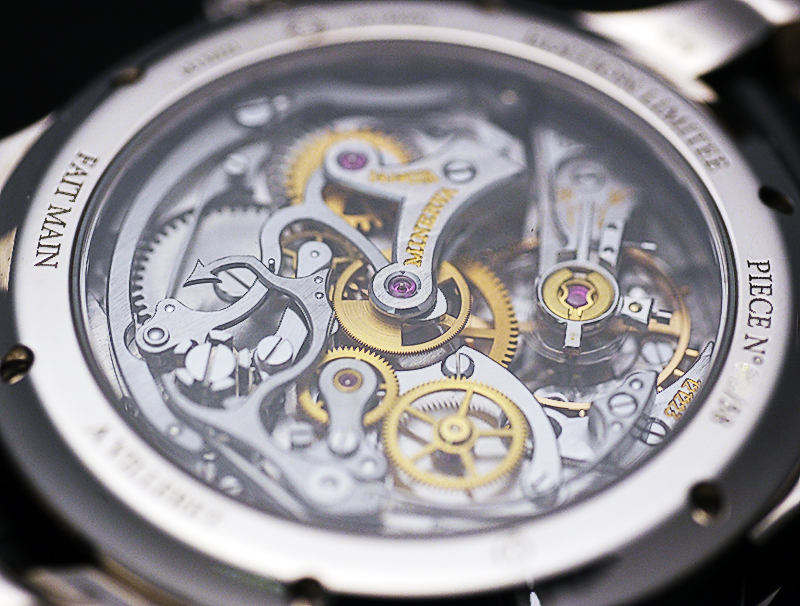
First the front... and then the movement side featuring the Minerva Calibre 13-21...

The more important point is this - how does one make such a timepiece? As Montblanc, they are probably more well-known as a brand of writing instruments. Their original range in their manufacturer in Le Locle churns out commercial quantities while this, and other high end pieces are done in their other location in Villeret. The Richemont group who owns the movement maker Minerva SA started that collaboration and this and a few others were the result of that collaboration.

The black and white enamel dials are forged using the Grand Feu techniques which fires the enamel in excess of 800 degrees Celcius. Enamel dials are said to be very long lasting. That delightful shine on the enamel dial is unmistakably the work of a master. It is said as much as 30-40 dials are made for one good example!

Even the hands and markers are extremely well done making the timepiece an overall handsome proposition. The actual piece in metal is even more alluring - blue hands and red chronograph seconds hands. What a package!

At the back, what a glorious sight. Expertly hand finished column wheel chronograph movement is a sight to behold. And what more the signature devil's tail. Julien tells me hours and hours of work goes into finishing the movement and adjusting it before final encasement. And the results are stunning!

And the movement is something altogether. Not just any movement but the Calibre 13-21 which is a vintage calibre from Minerva. Smaller than the Calibre 16-29 which is suited for the larger 1858 Chronograph Tachymeter (44mm timepiece), the calibre 13-21 is no less impressive in its finishing and layout. The words Minerva clearly engraved on the movement.

The timepiece is a very wearable 39mm especially for the Asian wrists and in particular, mine!

A final look at the two metals. This link will bring you to my previous post on the rose gold black dial version. Both are equally magnificent. I just happen to be lucky enough to get my hands on the rose gold piece.

But it is not too late - there is still one piece left of the white gold version and it is available at the Marina Bay Sands Boutique. Head down there and see if you agree with me that this is one classy timepiece.

Wednesday, July 6, 2016

Another Icon in Sketch

The Portuguese by IWC was what started my horological intrigue. Pure, simple and yet alluring.

Even in a sketch, the simplicity is so beautiful. The proportions perfect.
 photo IMG_2938_zpsbf5e098b.jpg

And the movement side is equally breathtaking...
 photo IMG_2936_zpsbfaf203b.jpg
 photo IWCPortugueseJubilee01_zps33032ed7.jpg

But what the sketch can't show is the patina. That is something else altogether.
 photo IMG_2935_zps4a8c2da2.jpg

Having been released in 1993 to commemorate the 125th Anniversary this has been a much sought after timepiece for me. In 2014, IWC relaunched a special limited edition of the Portuguese Jubilee for the watch publisher Revolution.

Monday, June 20, 2016

Useful Features In a Timepiece

I am not sure about you but I have never really sat down to think what the useful features are in a timepiece.

Honestly, how often do you activate the chronograph function? What about that perpetual calendar especially those with the pushers? Even the date is something of a chore for some unless it is the big date.

Truth me told, I hardly use the chronograph feature on my chronographs. I know some say you could use it to time how long you park at a particular location etc., but really?

Enjoy the picture of the A. Lange & Sohne 1815 Chronograph.

The honest truth, at least for me, is the beauty of the 1815 Chronograph movement rather than the function itself. Now, how can you argue with a movement like that? I have to say, both the dial side and the movement side of the Lange 1815 Chronograph are gorgeous. But how often do I use the chronograph function?

Then again the perpetual calendar...

A nice feature to have and I believe that when they developed the Quantième Perpétuel, most owners had one watch to their name. So if that timepiece were with you all the time, it makes sense to keep it running and in order not to have to make those minor date changes (30 and 31), the perpetual calendar was invented. But today? Well, it really becomes a status symbol than any "useful" feature.

Don't get me wrong, I love the perpetual calendar watch. A great invention. But how often do you use the function especially when you need to hit those pushers to have the day, date, month and moonphase aligned? Well, doesn't really matter when the movement is as nice as the Moser Perpetual One.

What I really like - the Zero Reset...

What I would really like as a "regular" feature in a timepiece is the Zero Reset. When it comes to time setting, I am a stickler for accurate time setting i.e. having to wait till the seconds hand hits zero before pulling the crown to set the time. Some timepieces with this feature are the Lange Saxonia and the Glashutte Senator Chronometer.

Featured here is the Lange Saxonia belonging to a friend of mine. The Zero Reset is a patent belonging to manufacture A. Lange & Sohne.

And the case back showing off the automatic movement.

The Glashutte Original (GO) Senator Chronometer is also another timepiece featuring a reset seconds hand when the crown is pulled. But they go one step further in the attempt to improve accuracy during time setting. Not only does the second hand return to the zero position when the crown is pulled, the minute hand changes in full minute increments i.e. the minute hand progresses to the next minute index. And when one depresses the crown, both the seconds and minute hand move in tandem.

And the case back revealing a three quarter plate typical of German watchmaking...

With the Zero Reset feature, the seconds hand returns to the 60 second position when the crown is pulled. As far as I know, the two brands that has this feature are A. Lange & Soehne and Glashutte - both German brands. Is that a coincidence? And then the question of "How difficult is it to make?" Then again, is there an easier and more innovative way to develop this feature?

GMT or Two Time Zone

A more regular (and useful) feature is the GMT or two-time zone which of course is essential for the frequent traveller. The Reverso from Jaeger LeCoultre comes to mind...

With the two time zone, the timepieces allows the traveller to track local time (where he is) and his home time. With the Reverso, this is done with two dials on the same movement. But the more common variation is the GMT where the timepiece features another 24 hour bezel like in the Rolex GMT II featured here.

There is yet another variation - the World Timer. Featured here is the Patek 5131R...

And the Andersen Genève World Timer, 5th Edition.

One more thing before I sign off this post - hacking seconds... I like to be able to pull the crown and the seconds hand stops at 60. That allows me to set time more accurately. So what's your thoughts about useful (or not) features in a timepiece?

Saturday, June 18, 2016

Beauty is in the Enamel - The Montblanc Villeret Vintage Pulsographe

When two enamel dials come head to head, what is your preference?

Many thanks to the folks at the Montblanc Boutique at Marina Bay Sands and in particular Julien Miribel and Katharina Ueltschi. I managed to capture the beauty of the white gold, white dial Villeret Vintage Pulsographe.

Compare the black dial version in a rose gold case against the white dial version in a white gold case - which would you prefer? The dials are fired using the Grand Feu technique at temperatures exceeding 800 degrees Celsius. A Grand Feu enamel dial is said to be very durable and I can attest to that. Take a look at my Lange pocket watch which dates back to 1908 - the enamel dial is still pristine!

I had earlier written a post for my friends at Deployant featuring my experience in acquiring the beautiful rose gold, black dial piece.

A look at the handsome pair.

Subsequently, I put out my own blog on the Villeret 1858 Vintage Pulsographe. Needless to say I am extremely happy with the acquisition and definitely a keeper. Look out for more photos of the white gold version. Coming soon to a screen near you!