Tuesday, November 29, 2016

Deserved Winner at GPHG - MB&F Legacy Machine Perpetual

The Legacy Machine Perpetual was launched in 2015 and what an impact it made.


Max and his friends certainly know how to make the complicated look as good as it does. Clean, uncluttered yet sophisticated. I can’t put my finger on it, but despite the high complication of the mechanism, the look just works for me. A gorgeous art piece in my humble opinion.

This year, the 2016 edition of the Grand Prix d’Horlogerie De Genève honoured Max Busser’s Legacy Machine Perpetual with the Calendar Watch Prize. And what a field that was competing in this category - LM Perpetual, H Moser & Cie’s Endeavour Perpetual One Concept Funky Blue, Chopard’s L.U.C Perpetual Chrono, Bovet’s Virtuoso VII Retrograde perpetual calendar just to name a few. Strong field but the LM Perpetual came out tops. Not surprised…

The beauty of the LM Perpetual is the fact that many perpetual calendar timepieces use the sub-dial layout but while MB&F adopted a similar sub-dial layout, he also designed it with an “open work” concept. Brilliant!

Congrats to Max Busser and the talented Stephen McDonnell for the win! Thoroughly well deserved.

Sunday, September 25, 2016

GAÏA Prize 2016 - Vianney Halter Honoured!

2016 marks another milestone for talented watchmaker Vianney Halter as he is awarded the GAÏA PRIZE by the Musée International d’Horlogerie of la Chaux-de-Fonds in the Craftsmanship and Creation category. The following is a press release from the man himself.


Vianney Halter was born in Suresnes, in Paris outskirts, in 1963. His father was a train driver for French National Railways. In his oldest memories, he remembers his father bringing home old machines and mechanical parts that fascinated him. In a way, early exposure to powerful locomotives, steam engines and control instruments might be the origin of Vianney‘s attraction to mechanics and engineering.


At the age of fourteen he set his mind on deepening his knowledge of mechanics, took the train to the capital and enrolled himself at the Ecole Horlogère de Paris (Paris Watchmaking School). After graduating in 1980, Vianney Halter spent the first ten years of his professional life restoring antique horological items. This gave him a broad knowledge about the art of horology.


Being independent since 1994, he produced various timepieces for famous brands such as Harry Winston, Breguet and Audemars Piguet, among others. Starting 1998, he also dreamt up and developed his own collection of wristwatches. His creations have been welcomed as avant-garde pieces and are considered as instigators of a new trend in watchmaking. Vianney makes atypical timepieces in a stunningly traditional manner, using his unique style, his own technical patents and trademarked designs.


As a matter of fact, when he presented his first model, the Antiqua Perpetual Calendar in 1998, the watch was immediately regarded as a “relic from the future”. This enabled him to assert his creativity and granted him access to the AHCI. In the following years, Vianney Halter created 10 different wristwatch models. However, the high level of craftsmanship keeps the production at a confidential level, as less than 500 watches bearing Vianney Halter’s signature were ever produced.


In 2013 he unveiled his new creation, the Deep Space Tourbillon: a futuristic three-axis Tourbillon under a crystal dome. As with the Antiqua, Vianney innovated and created general surprise with a previously unseen mechanism and bold design. These 22 years of independence spent perpetuating watchmaking art and his contribution to the contemporary horological landscape have won him eight prizes. The quality of his expertise placed him as one of the 64 players who were selected for the White Book of the FHH (Fondation de la Haute Horlogerie). The white book aims to delineate the idea and principles of Haute Horlogerie.

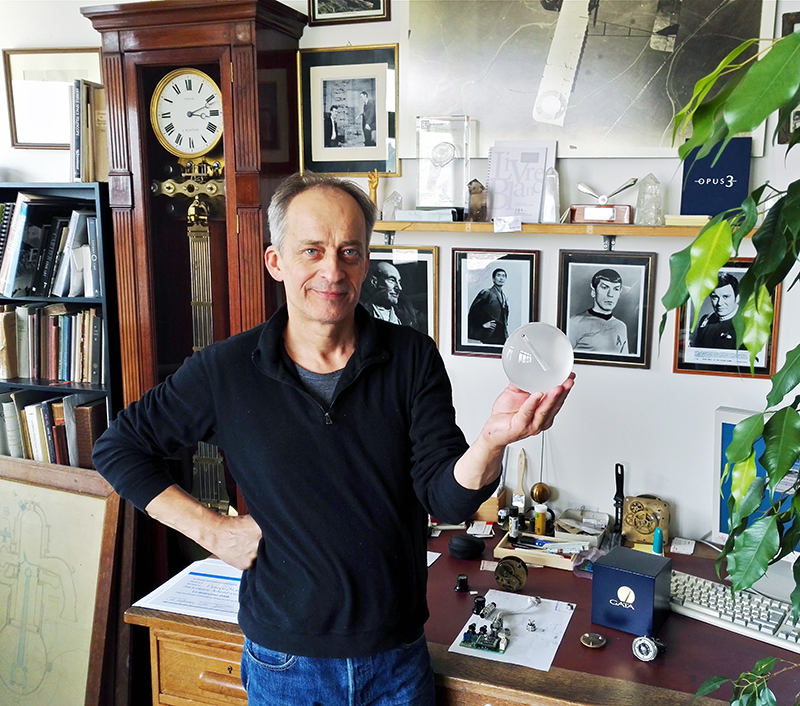
Vianney at his office.


2016 Laureat GAÏA Prize - Message from Vianney

It’s a great pleasure to share with you the following news: I have been awarded GAÏA PRIZE by the Musée International d’Horlogerie of la Chaux-de-Fonds, on Tuesday, along with the historian Roger Smith, professor Giovanni Busca and entrepreneur Pascal Rochat.


The jury has designated me as the 2016 laureate in the Craftsmanship-Creation category for my “contribution to the renewal of aesthetic and technical codes in contemporary watchmaking, showing a respect for craftsmanship, without ever making concessions to conformism”.


I’ve been touched by these arguments as they refer to my global way of working. This represents the recognition of years of research, ideas, development, independence and perseverance in fighting for a compromise less horology. I love to create crazy time machines, spend time with antique things, seek, understand, fix, deconstruct, rebuild... and this distinction incite me to continue in this way. Reward my all career motivate me to boldly carry on exploring and seek out in horology universe.


It is also for me the occasion to thank the GAÏA jury and the Musée International d’Horlogerie for this precious award, attributed in a totally independence and neutrality. Attributed since twenty years at the autumn equinox, the GAÏA PRIZE prevails as a reference in the time measurement vast world and honours prominent figures who have contributed and who contribute to the reputation of watchmaking, through its history, its technology and its industry. It annually recognises the considerable and undeniable contribution that its prizewinners have made to watchmaking, to its knowledge and culture.


A distinction rather than a Prize, therefore a spontaneous application is not possible; applications presented by third parties allow the members of the Jury, prominent figures from Switzerland and abroad from various fields, to assess each contribution on a neutral basis and to choose a winner. The independence of the Jury is granted by its President, the Curator of the Musée International d’Horlogerie.


Message from Eddie

Congratulations to Vianney Halter on his winning the GAÏA Prize. Definitely a worthy winner given that he has devoted so much to Haute Horlogerie and designing some of the most iconic pieces.


I have done the a few posts on the timepieces by Vianney. Starting with the Antiqua Perpetual Calendar and also the Goldpfeil Jumping Hours Moonphase. Both timepieces belong to good friends of mine.

While most of his timepieces are already out of production, Vianney still produces the Deep Space, The Antiqua Perpetual Calendar, the Trio Grande Date and the Classic Janvier Moon & Sun.

Text as provided for my Vianney and all watch pictures are mine except those of the Deep Space.

Monday, September 5, 2016

Unique Timepieces and Customisation

Some time back in 2009, I met a Singaporean watch enthusiast who wanted to start his own watch brand.

Reeds Tan started Reedsco shortly after our meeting. Prior to our meeting, Reed was already tinkering with customised timepieces. His earlier works were focused much on developing customised dial for timepieces with cushion shaped cases.

This timepiece comes with a customised python skin strap made by another friend of mine Jason of JnS. The timepiece comes with a screw-in crown for better water resistance.

He first started with a "rusty" dial type and then became more adventurous playing with different techniques and experimenting with different mediums. I actually purchased one of them "rusties" but passed it to a friend who had taken a liking of that special piece.

This is one of his later dials, having improved his technique to develop new texture. He tells me it takes it at least one to two weeks to experiment and through trial and error develop specific dial colours.

And the close up of the sandwich dial. Why sandwich you ask? Well the bottom base (white) is luminous and the top dial is textured and placed above the luminous dial like a sandwich. At night, the luminous bottom lights up.

It takes lots of practice and patience to develop a dial like this one. Well finished.

Over time, Reed developed his technique for making lume on his timepieces.

And another of his experiment yielded "The Pyramid". Seen here with a strap made from a baseball mitt.

According to Reed, he discovered the pyramid dial by accident. It was an experiment "gone wrong" but as with all good inventors, you make do with the circumstances and turn it around. Turn it around he did and he came up with "The Pyramid" dial.

Nice texture and colours on the dial. Blessing in disguise I guess. Reed tells me I have the first two pyramid timepieces he made. Let's call them Number 1 and Number 2!

A close up of the sandwich dial - well painted and finished.

And the lume on the pyramid dial.

Now for the case back. The open case back reveals a UNITAS calibre movement. Robust and reliable.

And decently finished too. At least Reed is honest about his work. He tells you what movement he uses, where he sources it from. He does not use an unfinished movement, hide it under a solid case back and hope no one finds out. And oh... gives it a nice sounding name and makes it a Limited Edition and charges you an enormous amount of money!

And just so we can wear similar pieces, I had one made for missus - in pink no less and with a red hornback croco strap.

These are trendy pieces and are good value for money. Reed makes them affordable - that has always been his goal. To make timepieces that are reliable and affordable. With his Reedsco range, he is fulfilling that dream.

Saturday, August 27, 2016

Seiko Prospex Kinetic GMT PADI Edition

Released together with the Pepsi Turtle, the Prospex Kinetic GMT is another PADI Edition released by Seiko.

The difference between the two is that the SRPA21 Pepsi Turtle is a mechanical automatic timepiece while this SUN065 is the Kinetic GMT Diver's in PADI's traditional blue and red livery.

So what is Kinetic? Seiko developed this analogue quartz technology that uses the body's motion to generate energy to power the timepiece. So like an automatic timepiece, the "automatic winding" winds the timepiece that powers the quartz movement. The winding helps store energy in the rechargeable battery for up to 6 months. 250 swings will reserve up to 1 day of power. When power reserve is down to about 24 hours, the seconds hand will increase in 2 seconds interval.

The Kinetic also comes with a rather cool power reserve feature. Located at 2 O'Clock is a button when depressed will use the seconds hand to display the power reserve. The instruction manual tells you that is is best to push the button when the seconds hand reaches 12. When the button is pushed, the seconds hand will advance forward - if it stops at the 5 minute marker, it has more than 1 day of power reserve. If it stops at the 10 minute marker, it has more than 7 days power reserve. And if the seconds hand stops at the 20 minute marker, the timepiece is suppose to have about 1 month of power reserve. And when the seconds hand stops at the 30 minute mark, the timepiece will have about 6 months of power reserve.

And the even cooler part is that the timepiece will continue ticking at the correct time after displaying the power reserve as the time catches up.

The case is rather interesting in that it features a two part construction first made in 1975. Nicknamed "Tuna", the derivative came about as the case resembles that of a tuna can. What is different for the PADI version is that the inner case is blue.

Sized at 47.5mm, the timepiece does not wear like one. The shorter lugs made this monster a wearable beast. Comfortable for my puny wrist. Well machines and finished in brushed steel. Top quality for a timepiece at this price point! The "outer" case is secured to the inner one with four screws - two on each side.

The rotating bezel is as smooth and exact as one would expect on a professional diver. Well done by Seiko! The bezel mechanism is a 120-click uni-directional type.

The timepiece also has a GMT feature. But what is exceptional is that as one advances or reverses the hour hand to adjust to local time, the date also advances forward and reverses backward.

The finishing on the GMT hand is also in the PADI red unlike the normal hands in white. The sword like hands is also coated with lume filling.

The minute and hour hand is steel and also filled with lume. But I cannot understand why there is the black line right in the middle of the hands.

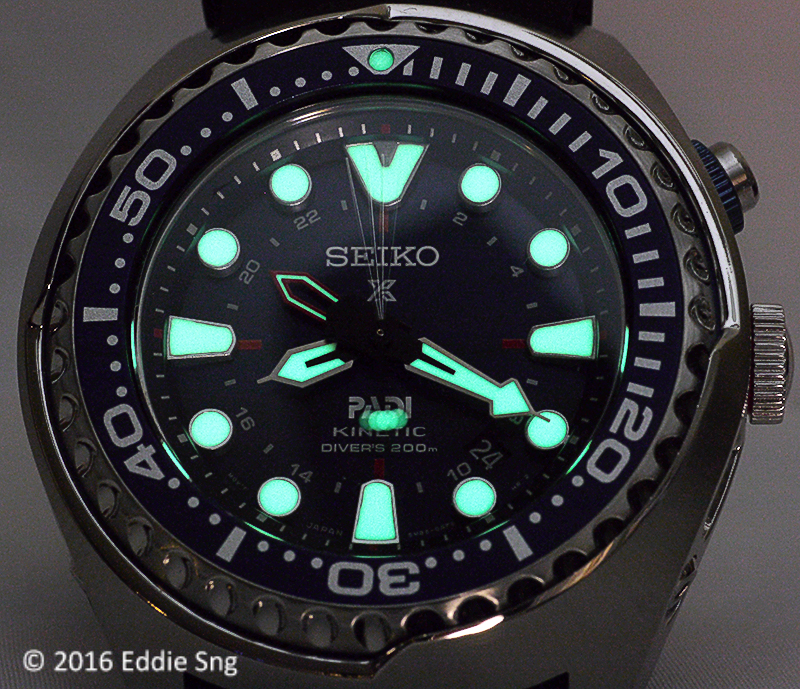
Speaking of lume, the lume shot of the Kinetic GMT.

No doubt a Seiko...

The sunburst patterned dial is not as attractive as the Pepsi Turtle aka SRPA21. Despite its larger size, the dial of the Kinetic GMT looks smaller than the Pepsi Turtle.

The minute markers are angled inserts with lume filling. Lovely detail that adds a nice overall touch to the timepiece. The bezel is in matching blue with the dial colour.

The case back of the SUN065 features the usual tsunami logo and all the relevant information. Beating inside the Kinetic is the Caliber 5M85. As explained, this is a quartz movement but the winding is mechanical in nature. As one shakes the timepiece side to side to activate the winding mechanism, one can hear the whirring sound of the rotor unlike a traditional automatic timepiece which tends to be quiet. I guess it has got something to do with the Kinetic calibre.

The caliber number is clearly indicated on the dial side as with many (if not all) Seiko timepieces. Seiko says the accuracy of a Kinetic timepiece is to within 15 seconds deviation per month.

My only gripe is the rubber strap on this timepiece. Don't get me wrong, the strap is correct for its actual purpose but I am a land diver and no plans to go diving with my timepieces. And because the timepiece is made to be worn on the outside of a wet suit, the straps are extra long. So I have to swap this out for either a Nato or for a leather strap.

The timepiece retails at S$639.60 inclusive of GST and it is only slightly more expensive than the regular version of the Prospex Kinetic GMT. So between the Kinetic GMT and the Pepsi Turtle, which do you prefer?